

My story
I was about 17 years old when I started experiencing pain in my hips. I was convinced it was just a karate or ballet-related injury, and with some time, I’d be ok… or in the words of my karate teacher, “you just need to push through the pain”. But the funny thing was, that made it worse… I have this hazy memory of my mum taking me to the GP, who told us, “Come back when you can’t walk. You’re too young to have a hip issue”. This was one of the first times I was flat-out stunned by what a healthcare professional had said to me, so I kept pushing through, and by the age of 18, I was crying when I walked.
Two hip surgeries later, I have been left with chronic pain for the last 10 years. For the first 5, I tried my best to recover. I carried on with my normal life, but things weren’t improving the way I had hoped they would. By the age of 24, I started to realise maybe a walking stick might help me, especially now that I was experiencing dysautonomia too. So for a few years, I slowly got used to the stick, no one really commented on it, and I started to feel like it was just an extension of me! However, medical professionals would continue to press me as to why I felt I needed to use it, and I was so exhausted that I gave up trying to answer that question.
A few years later, my chronic pain has spread over my body, my fatigue levels are at an all-time high, and I feel rotten almost all the time. I was barely leaving the house, and I was absolutely miserable. How could I go from so active to finding it hard to get off the sofa in what felt like such a short time?
A couple of years ago, I started thinking about getting a wheelchair. Just a cheapish one to use every now and again when I feel my worst. I really wanted to get out into nature and feel a little bit more like me again. I started bringing it up to the healthcare professionals I was under at the time, and almost all of them said that I was “too young” , “just move more”, “do more physio”, “a wheelchair is giving up”.
I had this extra challenge, though. The professionals in the OT group chats I was in were echoing the same message, but about our clients… citing that telling a client it’s ok to use a wheelchair when they can walk is just going to decondition them. It was like wheelchairs were the worst thing in the world and to be avoided at all costs. So I had both my own healthcare professionals AND those in my network chiming out the same message over and over again, so for a year I kept trying, went to more physio appointments, tried more medication, got regular sports massages, tried to walk more, but it was no use, I was still at square one. The medication made me feel awful, the massages helped take the edge off the pain for the rest of that day but didn’t have a lasting effect, the physio and walking helped a little but I routinely would have big flare ups or energy crashes that would wipe me out…. so progress was miniscule (and i kept being discharged for “non-compliance” because i couldn’t keep up with the daily 10 exercise physio routine with the flareups). So I went back to my GP and asked “well what do I do now? do you need to refer me to someone else, what can I try next?”, and their answer turned my blood cold “there is nothing else, we have tried everything we can offer you, you’re going to have to just carry on as you are. Sorry, the NHS isn’t equipped to help people in your position”. It’s safe to say I was horrified. I didn’t know what to say except “well, I feel pretty hopeless now…” and went to have a big cry in the car.
So I decided I’d try a wheelchair, what have I got to lose?. I bought a very basic manual wheelchair, which allowed me to self-propel and be pushed, about a year and a bit ago, and honestly…. I wish I had done it sooner.
All these years, I didn’t get out, I didn’t go to things I desperately wanted to, all because there was no way I could walk that far or stand for that long. Now I can access nature, I can sit amongst the trees and listen to the birds, I can go on the dog “walk”, I can go to the event, I can go to an appointment and save some energy for later in the day, I can go round a shop, I can just go for a “walk”(wheel) something which id taken for granted for a long time.
And at the core of this, the biggest difference is that a wheelchair hasn’t deconditioned me; it’s enabled me to do MORE. This is something I feel some healthcare professionals don’t understand. They see the wheelchair as us “giving up” but actually it’s the opposite, it helps us to live again! While I acknowledge that some physical changes may occur with using a wheelchair more, for me, the trade-off was so clearly worth it
I have seen so many stories on TikTok, speaking with other OTs and other chronically ill & in pain folk who have been told not to use a wheelchair and have had a huge dip in mental health because they are stuck inside, and when they got a wheelchair, the world opened up again. Why aren’t we factoring this in?
Cultural context
A few months ago, I had my own OT (I believe it’s important for therapists to have therapists!) appointment in which I shared about my wheelchair and waited with bated breath, fully expecting to be questioned and criticised, but this time that didn’t happen! Instead, she explained to me how she trained in South Africa, where she felt they embraced wheelchairs for ambulatory users and their wheelchair services were much easier to access than our NHS system, which can be incredibly difficult for ambulatory users to access in some areas. Firstly, it was so lovely to hear her commend me for using the wheelchair to help me live my life rather than criticising me, and secondly, it took me back to my roots in anthropology and reminded me of how different healthcare is across the globe.
It reminded me that this was never really about my body, but actually it was about our culture. That OT trained in the same evidence base, but had seen different clinical judgements in different cultural contexts.
So I started reflecting more deeply on this: what cultural values are we protecting when we tell someone they will decondition, or that they are too young for an aid?
I remember a lecture in medical anthropology where we discussed how what counts as healthy, normal, or expected care isn’t universal; it varies across the globe. For example, in many cultures, multiple people breastfeed the same baby, and the children become milk siblings. Whereas our Western norms would usually perceive that as strange because it crosses a boundary, that our culture decided matters to us. Wheelchair gatekeeping appears to cross a boundary in a similar sort of way, but instead, it’s one drawn around independence.
It feels as though our Western capitalist lens ties personhood to productivity and independence.
It feels as though the phrases like “you’ll decondition” aren’t just about society’s worries about our muscles getting weaker, but instead this fear that you’ll become (or be seen as) a certain type of person: dependent, unproductive, visibly disabled. All of which we know are pretty stigmatised right now.
Here we go… again…
Recently, I had a physio appointment for a separate situation, and the physio still took it upon himself to look at my walking stick and hear about my wheelchair use and say, “Well, you need to be careful, you need to move enough, that’s how our bodies get better”. Immediately, I could feel myself shutting down; it was happening AGAIN. The ironic part is how I’d seen my own pain OT the week before (the lovely lady who I mentioned previously), who advised me that it was great that I was using my wheelchair to get out more.
It’s absolutely exhausting to have to continuously justify why you need an aid, an adjustment, a support for something you worked so hard on accepting within yourself and battling with your internalised ableism for so long. And you finally get to a place where you are comfortable using the supports, and yet you still get questions, and you still have to justify it to seemingly everyone.
I don’t owe everyone an explanation of why I use my wheelchair, my stick or anything else for that matter. That is no one else’s business but mine. Don’t get me wrong, as an OT myself, sometimes it’s useful to discuss these things with our healthcare professionals and have their opinion, but ultimately it’s our choice who we disclose what to.
If it’s the choice between pushing myself to walk more, having huge painful crashes that prevent me from working or being able to do basic things like get to the toilet or leave the house extremely rarely, losing my sense of who I am, never being able to engage in my hobbies and ultimately having a mental health crisis
OR
Using a wheelchair, getting out into nature, being able to go to the shops, go to events, prevent huge flare-ups, still be able to work and engage in my interests, and have improved mental well-being
Why on earth would I choose option 1? Don’t I deserve to live a little?
What do I do about this, as an Occupational Therapist?
So how do I take my experiences and apply them to my own clients? Some of the biggest questions I ask my clients when they mention debating getting a mobility aid are:
“Would it let you do more of what matters to you?”
“Would it help you do more of what you love?”
“Would it bring life to your days?”
“Would it enable you to get into your community?”
And oftentimes the answer to these questions is a resounding “YES!”. And the biggest takeaway for me is how, when the answers to all these questions are “yes”, then that mobility aid actually helps that person do MORE. And, thinking about it from an anthropological perspective, we are applying a more contextual way of thinking to these discussions, considering what the environment and social context can make possible rather than just what the body can be “trained” to do.
If there is one thing I want you to take away from this article, it’s this:
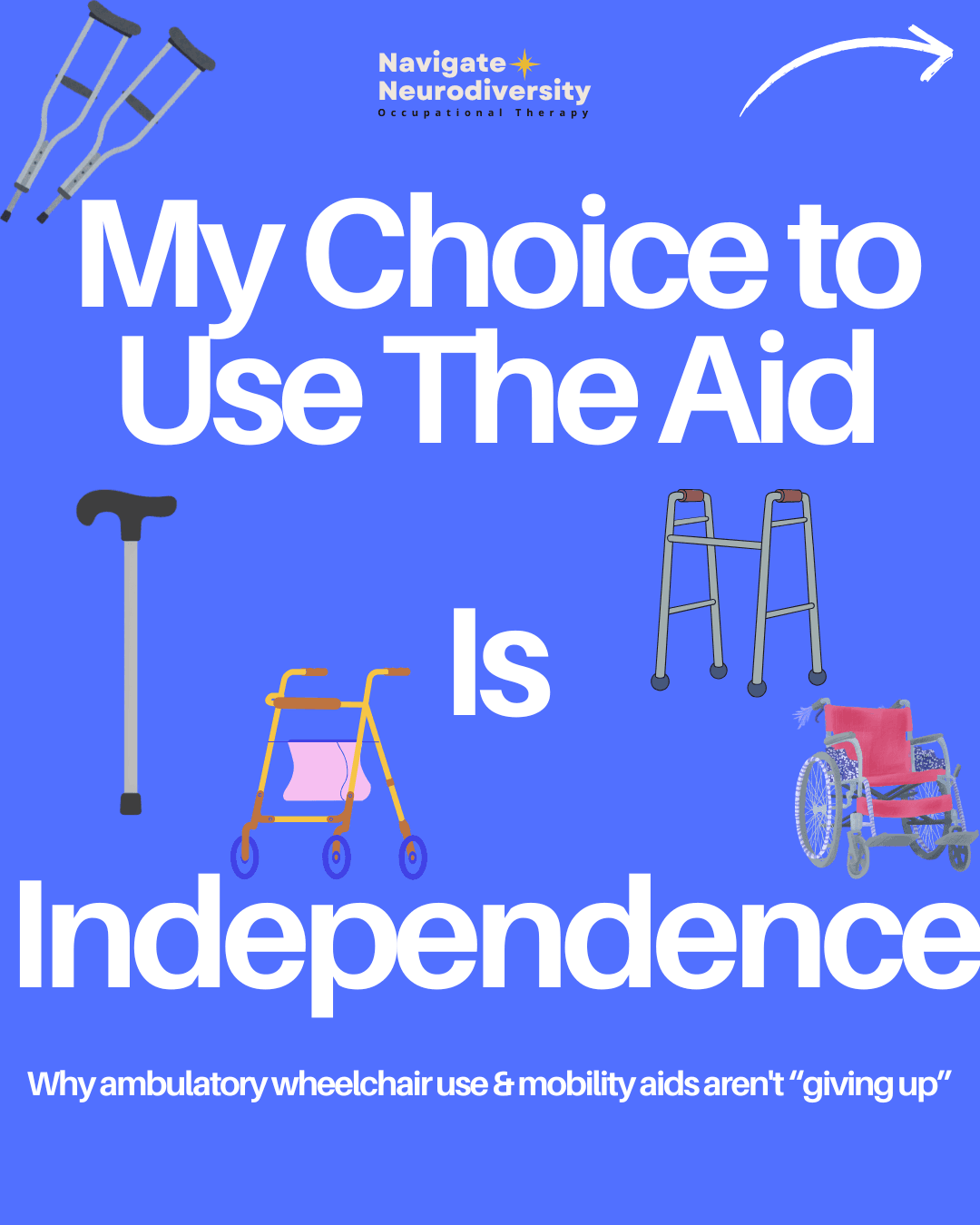
I use my mobility aid not because I can’t walk, not because I am lazy, not because I have given up. I use it because I have to preserve my energy to fight against the system every single day, just to survive. Society, Capitalism and Western ideologies and values might demand I aim to be more “independent” by pushing myself to the breaking point every day, but really, my choice to protect my capacity by using the aids IS my independence.
Thank you for reading a bit about my story and recent reflections. I’d love to hear from you if you can relate to my experiences and how these kinds of ableist perspectives have shown up when you have accessed healthcare.
Take care,
Alex
(she/her)
Disclaimer: This was created by an Occupational Therapist for informational purposes only. It represents my personal perspective, not clinical advice. This article does not replace assessment, diagnosis, or treatment from healthcare providers, and everyone is different. This article is not a substitute for professional judgment regarding your specific health needs. The views expressed are those of the author and do not necessarily reflect the views of any organisation or affiliated body.
Published: 28th July, 2026 | Updated: 28th July, 2026